Ibn al-Athir and Noah's Ark
An exciting discovery in the follow-up to the symposium in Sirnak in October 2025. Dedicated to my researcher friend Bill Crouse on his 82nd birthday today
July 20, 2026
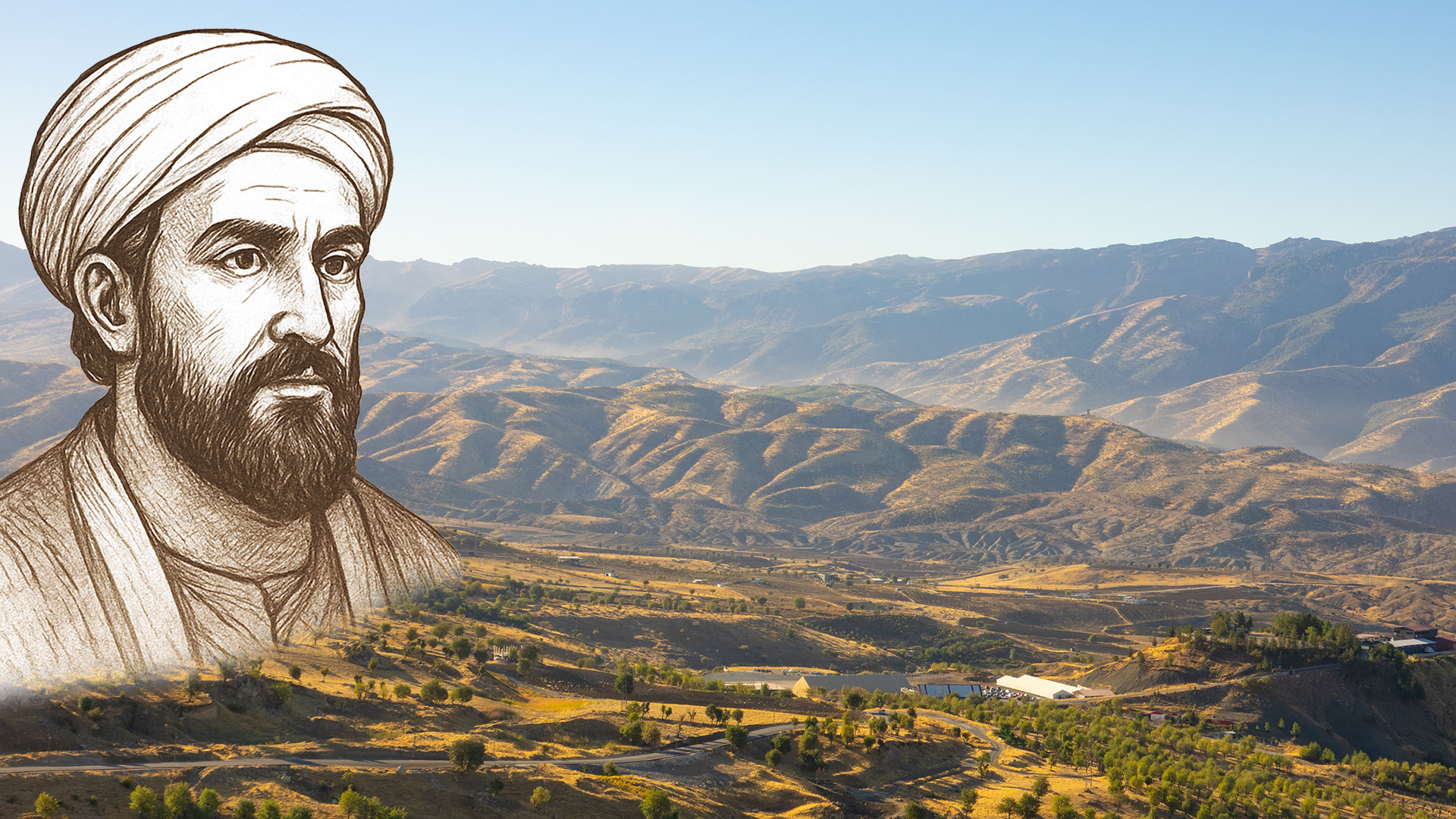
In the summer of 2025, I discovered the announcement of a symposium on the Ibn al-Athir brothers from Cizre at the University of Sirnak, and I wanted to seize the opportunity to travel to the mountain of Noah's Ark once again and, according to the program, to reach the summit of Cudi Dagh (see my travel report, in German). I searched for a topic related to these brothers, of whom I had never heard before, and struggled to find one. There seemed to be no direct connection to the subject of Noah's Ark. So I conceived a paper on a different motif and gave a presentation about Ali Ibn al-Athir and Sennacherib as cultural twins. In it I wrote: »Ali Ibn al-Athir does not explicitly mention that the Ark came to rest near his hometown.« The description of his work did suggest that he also covers primeval history, but I could not find any specific English translations of these passages. And in German there are only a few excerpts covering the period of the Crusades.
In the meantime, the symposium proceedings have been published as a PDF (İbnü'l-Esîr el-Cezerî Kardeşler, Özgür Yayınları, Gaziantep 2026, Open Access under DOI 10.58830/ozgur.pub1283), and my own contribution can be read on academia.edu and is documented on this website in English and German.
At some point in recent days, I had the idea of handing the complete book of more than 900 pages over to the AI language model »Claude«, asking for an overview and summary of the mostly Turkish articles, as well as an analysis of whether there were any points of connection to my research. And indeed, there was an exciting result!
Bill Crouse from Texas has researched the ancient sources on Mount Cudi extensively; there are manifold references in pagan, Jewish, and Christian literature, as he points out in his article »Five Reasons Noah's Ark Did not Land on Mt. Ararat; Five Reasons Why It Did Land On Cudi Dagh«. He presented this article as early as 2013 at the first Noah Symposium in Sirnak (a PDF document and a video recording are available on this website).
An expanded two-part article is now available: »Geographical and historical concerns in Genesis 8:4«, part 1 and part 2, both on creation.com. Incidentally, I had the honor of taking part in the peer-review process of that contribution — without his knowledge. My book »Das Rätsel der Arche Noah« (»The Mystery of Noah's Ark«), published in 2014, also drew on Bill's research. He mentions several medieval Muslim scholars who point to the precise geography in which the Ark mountain of the Qur'an is embedded.
To these sources, a further very important one has now been added — from one of the most famous Arab historians of the Middle Ages altogether: Ali Ibn al-Athir (1160–1233), born and raised in Jazirat Ibn Umar, today's Cizre at the foot of Cudi Dagh.
In the symposium proceedings, Abdurrahman Yapar (University of Sirnak), in his chapter on the Qur'anic references in Ibn al-Athir's historical work, points out how the historian narrates the landing of the Ark — following the Qur'an (Surah 11:44), but supplemented by remarkable geographical details.
I then verified the passage with the help of several AI systems (Claude, ChatGPT, and Google Translate) in the Arabic original, in the classic Leiden edition by Carl Johan Tornberg (1867). There it says (vol. 1, p. 52; AI-assisted translation from the Arabic, as no English or German translation of this part exists):
»The ship drifted over the whole earth without coming to rest, until it came to the Sanctuary [of Mecca]; it did not enter it, however, but circled the Sanctuary for a week. Then it moved on across the earth, carrying them along, until it reached the Cudi — which is a mountain in Karda in the land of Mosul — and came to rest upon it. Thereupon it was said: ›Away with the people of the wrongdoers!‹ And when it had come to rest, it was said: ›O earth, swallow your water, and O sky, withhold!‹ And the water subsided; the earth soaked it up. Noah remained in the Ark until the water had abated. When he came out of it, he took for himself a place in a district of Karda, in the land of the Jazira, and built a village which they named ›Eighty‹ (Thamanin). It is now called ›Market of the Eighty‹ (Suq ath-Thamanin), for every single one of those who were with him built himself a house — and they were eighty men.«
The Arabic original text can be accessed digitally in the Dar Sadir edition (vol. 1, p. 73) at lib.eshia.ir/22036/1/73.
Ibn al-Athir thus localizes the mountain of the Qur'anic verse twice over: the Cudi, he says, lies in Karda — the old district on the eastern bank of the Tigris, directly opposite his hometown of Cizre, whose name continues the ancient Qardu/Kardu — and, moreover, »in the land of Mosul«, the province to which Cizre belonged in his day. He also locates Noah's first settlement after the Flood, the »Village of the Eighty«, in Karda.
Ibn al-Athir thus explicitly localizes the Ark mountain and Noah's settlement in his immediate home region. He is therefore a further Muslim witness to the tradition of Cudi Dagh, which has been tied to the story of Noah from the times of the Qur'an until today. In my paper on Ibn al-Athir and his »cultural twin«, the Assyrian king Sennacherib, I show that this connection is much older than the history of Islam and reaches back to earliest times. In my contribution to the Cudi Symposium of 2021, I trace the history of the pilgrims to Noah and Cudi Dagh back to the very beginning of humankind.
So now, through my participation in the symposium, the publication of the proceedings, and the use of modern AI, a further important link between the story of Noah's Ark and the region around Mount Cudi has been established — and it can be recognized in the Western world, too, how close this connection is in the Arab world. One might object that it was natural for Ibn al-Athir to favor his home town; but his standing throughout the Oriental world and his reception up to the present day make it, with every new piece of the puzzle, ever weightier that the true landing place of Noah's Ark is to be sought on Mount Cudi — and not on the famous great Ararat or in its immediate vicinity.
We owe much foundational research to Bill Crouse, with which I stood ready on the morning of September 29, 2013, to reach the summit of Cudi — which I did not manage then, nor again in 2025, this time without Bill. Yet the research goes on. The mention of Thamanin in particular will interest another fellow Cudi researcher who was also on site in 2025 and who had already examined this Village of the Eighty in detail at the Noah Symposium of 2021: Stephen Compton. In his contribution »Locating the City of Thamanin« at the Cudi Symposium 2021, he traces the history of the town and reports on his discovery of the foundations of an ancient city. Ibn al-Athir's testimony now provides the history of Thamanin with a further medieval anchor point.